Those who forget the past are doomed to repeat it!!!
'Those who cannot remember the past are condemned to repeat it.'
George Santayana
It's NOT just our national or world history, it's family, friends,
and experiences. We should never let go of our past, our heritage, our
family, or our memories; both good and bad. They are what makes us who
we are today. I would be a strange blank canvas if all I did and all I
knew was erased. Why ask me to erase parts of my life in favor of some psychological theory that I will be a BETTER person because I have forgotten things and thrown memories away????
Remember the Holocaust!
Remember the Alamo!
Never forget Virginia Tech!
American Genocide 1915 Never Again!
Operation Fever Forget our Fallen Hero's!
Never forget 9-11!
In the early 1930s Germany was a democracy and out of money. The Great Depression and restitution payments to France and England from WWI meant the government was out of money. The only way it could pay its bills was to print more money. But each time they printed that made the German mark worth less so they just printed more. Eventually it took a basket full of marks to buy a loaf of bread. With both depression and inflation running wild savings were worthless and unemployment soared. Even the richest industrialists began to suffer. Desperate for a savior, the Germans elected a strong leader who promised to change everything... Adolf Hitler.
President Herbert Hoover had been a successful engineer and Republican. He personally helped thousands of Americans to escape Europe when WWI broke out. Hoover believed in business, not government, so when the stock market crashed in 1929 he felt that it was not the government's job to restore the economy. His government did little and the result of that was The Great Depression. The opinion of the millions of unemployed and homeless gathered in shanty towns made of clap board and primitive tents of this was obvious. They called their settlements "Hoovervilles". Promising to do Something, Franklin Roosevelt swept the 1932 Presidential election.
FDR was winning the economic battle. From 1933 to 1937 unemployment fell from 25% to 14%. Feeling the nation had permanently turned the corner on Depression, the up for election Congress in 1936 voted a popular bonus to veterans (over FDR's veto) and the Federal Reserve stopped giving a priority to boosting growth. Then in 1937 that era's stimulus program expired, raising taxes on all businesses and investment. It also seemed like a good time to implement an expensive, new social program. So they began gathering Social Security taxes, lowering everyone's paycheck. Within a year the "Depression with the Depression" had begun with unemployment rising to 19% and the economy again shrinking. Only WWII reversed the downward trend.
Also: http://www.ibtimes.co.uk/holocaust-memorial-day-2016-10-reasons-its-essential-we-never-forget-this-uniquely-evil-event-1540238
Tuesday, April 26, 2016
I don't believe in forgiveness!
What I see are people trying desperately to feel better, in the aftermath of terrible wrongs, of unfair treatment, of unearned slights, and horrific tragedy. I see people not doing ANYTHING to right these wrongs, to protest these slights, to heal these tragedies. Except, of course, to parrot, “forgiveness” that everyone around seems so comfortable with.
I hold people accountable. I work for justice in my own little corner of the world. If someone hurts me on purpose, I am angry. And, I stay that way.
Guess what? It doesn’t control my life.
I am not angry every day (after all, they are no longer in my life!). Although, I am angry when I think of the occasion or the person(s). I believe that this keeps me of slipping into relationships and behaviors not appropriate for someone with a healthy self-image. I don’t “rot”.
It’s not easy. Everyone else likes it when you “forgive”. But if you want me to “forgive” for myself, well, I’ll pass. I am fine how I am – and this is real smile on my face.
FROM: http://thoughtcatalog.com/robin-goode/2014/04/i-dont-believe-in-forgiveness-and-neither-should-you/
Frankly, though, the ‘forgetting’ part is sort of throw-away. You should never forget the wrongs done to you. Why would you want to? Forgiving, though, is another thing entirely. When somebody wrongs us, negative emotions can eat away at us. If we let go of our anger and resentment, we experience healing and reconciliation.
One could, I suppose, think that there are times and situations when forgiveness just isn’t called for. Suppose somebody does some terrible wrong to me and is totally unrepentant. It’s not at all clear that I should forgive them.
On the other hand, you could think that when you forgive, you shouldn’t do it for the sake of the wrong-doer. Rather, you should do it for your own sake, for the sake of your own mental health.
Of course, letting go of one’s anger and moving on won’t do you any good if the person is just going to turn around and do it again. And you could think that unless the person does something to really deserve forgiveness, you’d be a fool to forgive.
Even if you think forgiveness is all about what’s best for the forgiver and not at all about the forgiven, you can still think that there are times when one shouldn’t forgive -- without assuming the wrong-doer can ever deserve forgiveness. Forgiving a foreseeably repeat offender is a case in point. At least part of me thinks that there is nothing a person can do to “deserve” forgiveness. Forgiveness is always gift. It has to be freely given. We’re never morally required to forgive.
But the following thought still gives me pause. Imagine a person who is fully repentant for a wrong done. They’ve resolved never do it again. They’ve done everything possible to make up for their transgression. Why wouldn’t you forgive such a person?
My imagined resister to this line also thinks not. He will dig in his heels here and insist that while being unable to forgive might be some kind of psychological failing, it’s not a moral failing. He will grant that getting to the point of forgiveness can be really hard, even when you think it would be a good thing to do. If you can’t get there on your own, then maybe you need the help of a therapist. But the crucial point for him is that we don’t blame people who can’t forgive, we console them.
FROM: http://philosophytalk.org/community/blog/ken-taylor/2015/04/forgive-and-forget
I hold people accountable. I work for justice in my own little corner of the world. If someone hurts me on purpose, I am angry. And, I stay that way.
Guess what? It doesn’t control my life.
I am not angry every day (after all, they are no longer in my life!). Although, I am angry when I think of the occasion or the person(s). I believe that this keeps me of slipping into relationships and behaviors not appropriate for someone with a healthy self-image. I don’t “rot”.
It’s not easy. Everyone else likes it when you “forgive”. But if you want me to “forgive” for myself, well, I’ll pass. I am fine how I am – and this is real smile on my face.
FROM: http://thoughtcatalog.com/robin-goode/2014/04/i-dont-believe-in-forgiveness-and-neither-should-you/
Frankly, though, the ‘forgetting’ part is sort of throw-away. You should never forget the wrongs done to you. Why would you want to? Forgiving, though, is another thing entirely. When somebody wrongs us, negative emotions can eat away at us. If we let go of our anger and resentment, we experience healing and reconciliation.
One could, I suppose, think that there are times and situations when forgiveness just isn’t called for. Suppose somebody does some terrible wrong to me and is totally unrepentant. It’s not at all clear that I should forgive them.
On the other hand, you could think that when you forgive, you shouldn’t do it for the sake of the wrong-doer. Rather, you should do it for your own sake, for the sake of your own mental health.
Of course, letting go of one’s anger and moving on won’t do you any good if the person is just going to turn around and do it again. And you could think that unless the person does something to really deserve forgiveness, you’d be a fool to forgive.
Even if you think forgiveness is all about what’s best for the forgiver and not at all about the forgiven, you can still think that there are times when one shouldn’t forgive -- without assuming the wrong-doer can ever deserve forgiveness. Forgiving a foreseeably repeat offender is a case in point. At least part of me thinks that there is nothing a person can do to “deserve” forgiveness. Forgiveness is always gift. It has to be freely given. We’re never morally required to forgive.
But the following thought still gives me pause. Imagine a person who is fully repentant for a wrong done. They’ve resolved never do it again. They’ve done everything possible to make up for their transgression. Why wouldn’t you forgive such a person?
My imagined resister to this line also thinks not. He will dig in his heels here and insist that while being unable to forgive might be some kind of psychological failing, it’s not a moral failing. He will grant that getting to the point of forgiveness can be really hard, even when you think it would be a good thing to do. If you can’t get there on your own, then maybe you need the help of a therapist. But the crucial point for him is that we don’t blame people who can’t forgive, we console them.
FROM: http://philosophytalk.org/community/blog/ken-taylor/2015/04/forgive-and-forget

I'm tired of people telling me to "let it go"!
What is the big deal? Why should I forget? Why should I forgive? Why should I throw stuff away? Why should I give it all away and buy "new" stuff when I need it when the new stuff is garbage and my stuff and my grandmother's stuff is still working? I can never replace my cast iron waffle iron or my grandmother's blender. I can never replace the dolls and camera's that belonged to my family. My husband can never replace the Volkswagen motor he has. We can't replace the old Time, Look, and Life magazines from the 1950's. You can't replace the movie tickets, travel brochures, or postcards from trips gone by. You might say "take a picture" but then that's another organization nightmare.
From: https://www.psychologytoday.com/blog/tech-support/201410/when-you-should-and-should-not-forgive
For all that we culturally admire the ability to forgive—it’s associated with magnanimity, spiritual growth, and, of course, religiosity—it remains a somewhat thorny issue from a psychological point of view. In layman’s terms, the ability to forgive is widely seen as evidence of how high humans rank in the chain of being—animals don’t forgive, after all—so it conveys a moral superiority. But from a psychological point of view, two key questions remain: Why do humans forgive and, when they do, how do they hope to benefit?
As Frank Fincham wrote in an article with arguably the best image and title ever—“The Kiss of the Porcupines”—the human conundrum is that we need and want closeness and intimacy, but that need simultaneously leaves us vulnerable to being hurt, disappointed, and even betrayed by those closest to us. If it weren’t for "the quill problem"—in Fincham’s metaphor, two porcupines cuddle to stay warm, getting closer and closer, until a quill pierces skin and they have to withdraw—there’d be no need for forgiveness.
It’s all sobering, and true. And while it’s nice to echo the words of Alexander Pope—“To err is human; to forgive, divine”—it may not be universally applicable. You can’t reap the fruits of forgiveness alone; you need the cooperation, loyalty, and intent of the porcupine who stabbed you in the first place. On the other hand, forgiving someone whom you’re showing the door will most probably set you free.
From: https://www.psychologytoday.com/blog/disturbed/201208/why-you-dont-always-have-forgive
With time, you come to realize that you are moving forward, and it is usually at this point that someone will ask about forgiveness. At some point in your grieving process, someone, somewhere, will ask you if you forgive. Do you forgive your father or mother? Could you forgive your spouse? Many religions and therapies focus on forgiving a perpetrator so that the victim can ‘move on.’ The goal is to make sure that the victim does not become fixated on the hurt. This element is critical because if you become completely obsessed with your victimization, you will not be able to function. That is a fact. Fixating freezes you.
It may be surprising to learn how many people will pressure survivors to forgive a perpetrator. Family members tell them that if they don’t forgive, then they are going to Hell. In some cases, I’ve seen families turn their backs on victims of sexual abuse because the victims wouldn’t go along with the program and keep their mouths shut. They are told to forgive their attackers and let it go. If they cannot do so, then they are banished from the family unit. I’ve also seen women who stand up to their abusive lovers only to be eventually cut off by their children because they won’t simply forgive and let bygones be bygones. When they say they forgave and are moving on, they are accused of dredging up the past should they speak out, so back to isolation they go.
From: https://www.psychologytoday.com/blog/tech-support/201410/when-you-should-and-should-not-forgive
For all that we culturally admire the ability to forgive—it’s associated with magnanimity, spiritual growth, and, of course, religiosity—it remains a somewhat thorny issue from a psychological point of view. In layman’s terms, the ability to forgive is widely seen as evidence of how high humans rank in the chain of being—animals don’t forgive, after all—so it conveys a moral superiority. But from a psychological point of view, two key questions remain: Why do humans forgive and, when they do, how do they hope to benefit?
As Frank Fincham wrote in an article with arguably the best image and title ever—“The Kiss of the Porcupines”—the human conundrum is that we need and want closeness and intimacy, but that need simultaneously leaves us vulnerable to being hurt, disappointed, and even betrayed by those closest to us. If it weren’t for "the quill problem"—in Fincham’s metaphor, two porcupines cuddle to stay warm, getting closer and closer, until a quill pierces skin and they have to withdraw—there’d be no need for forgiveness.
It’s all sobering, and true. And while it’s nice to echo the words of Alexander Pope—“To err is human; to forgive, divine”—it may not be universally applicable. You can’t reap the fruits of forgiveness alone; you need the cooperation, loyalty, and intent of the porcupine who stabbed you in the first place. On the other hand, forgiving someone whom you’re showing the door will most probably set you free.
From: https://www.psychologytoday.com/blog/disturbed/201208/why-you-dont-always-have-forgive
With time, you come to realize that you are moving forward, and it is usually at this point that someone will ask about forgiveness. At some point in your grieving process, someone, somewhere, will ask you if you forgive. Do you forgive your father or mother? Could you forgive your spouse? Many religions and therapies focus on forgiving a perpetrator so that the victim can ‘move on.’ The goal is to make sure that the victim does not become fixated on the hurt. This element is critical because if you become completely obsessed with your victimization, you will not be able to function. That is a fact. Fixating freezes you.
It may be surprising to learn how many people will pressure survivors to forgive a perpetrator. Family members tell them that if they don’t forgive, then they are going to Hell. In some cases, I’ve seen families turn their backs on victims of sexual abuse because the victims wouldn’t go along with the program and keep their mouths shut. They are told to forgive their attackers and let it go. If they cannot do so, then they are banished from the family unit. I’ve also seen women who stand up to their abusive lovers only to be eventually cut off by their children because they won’t simply forgive and let bygones be bygones. When they say they forgave and are moving on, they are accused of dredging up the past should they speak out, so back to isolation they go.
Monday, November 02, 2015
Friday, September 18, 2015
Colin Firth IMDB Info
So I think I really like this actor!
Love this movie and the dance!!

Filmography from IMDB:
** movies I have seen
Genius (completed)--Max Perkins
Bridget Jones's Baby (pre-production)--Mark Darcy
Untitled Donald Crowhurst Project (post-production)--Donald Crowhurst
2014 Kingsman: The Secret Service--Harry Hart / Galahad **
2014 Before I Go to Sleep--Mike
2014 Magic in the Moonlight--Stanley
2013 Devil's Knot--Ron Lax
2013 The Railway Man--Eric
2012/I Gambit--Harry Deane
2012 Arthur Newman--Arthur Newman (Wallace Avery)
2011 Tinker Tailor Soldier Spy--Bill Haydon**
2011 King George VI: The Man Behind the King's Speech
2010 Main Street--Gus Leroy
2010 Steve (Short)--Steve
2010 The King's Speech--King George VI
2010 Arena (TV Series documentary)--Various characters
2010 Harold Pinter: A Celebration --Various characters
2009 St Trinian's 2: The Legend of Fritton's Gold--Geoffrey Thwaites
2009 A Christmas Carol--Fred**
2009 A Single Man--George
2009 Dorian Gray--Lord Henry Wotton
2008 Easy Virtue--Mr. Whittaker
2008 A Summer in Genoa--Joe
2008 Mamma Mia!--Harry **
2008 The Accidental Husband--Richard
2008 Mamma Mia: Deleted Scenes (Video short)--Harry (uncredited)**
2007 St. Trinian's--Geoffrey Thwaites
2007 Then She Found Me--Frank
2007 When Did You Last See Your Father?--Blake
2007 The Last Legion--Aurelius
2007 Celebration (TV Movie)--Russell
2006 Born Equal (TV Movie)--Mark
2005 Nanny McPhee--Mr. Brown**
2005 Where the Truth Lies--Vince
2004 Bridget Jones: The Edge of Reason--Mark Darcy
2004 Saturday Night Live (TV Series)--Host
- 2004 Colin Firth/Norah Jones--Host
2004/I Trauma--Ben
2003 Love Actually--Jamie
2003 Girl with a Pearl Earring--Vermeer
2003 What a Girl Wants--Henry Dashwood**
2003 Hope Springs--Colin Ware
2002 The Importance of Being Earnest--Jack
2001 Fourplay--Allen Portland
2001 Conspiracy (TV Movie)--Dr. Wilhelm Stuckart
2001 Bridget Jones's Diary--Mark Darcy
2000 Donovan Quick (TV Movie)--Donovan Quick
2000 Relative Values--Peter Ingleton
1999 The Turn of the Screw (TV Movie)--Master
1999 Blackadder Back & Forth (Short)--William Shakespeare
1999 The Secret Laughter of Women--Matthew Field
1999 My Life So Far--Edward
1998 Shakespeare in Love--Lord Wessex
1997 A Thousand Acres--Jess Clark
1997 Fever Pitch--Paul Ashworth
1996 The English Patient--Geoffrey Clifton
1996 Nostromo (TV Mini-Series)--Charles Gould
1995 Pride and Prejudice (TV Mini-Series)
Mr. Darcy
- Episode #1.6 (1995) ... Mr. Darcy
- Episode #1.5 (1995) ... Mr. Darcy
- Episode #1.4 (1995) ... Mr. Darcy
- Episode #1.3 (1995) ... Mr. Darcy
- Episode #1.2 (1995) ... Mr. Darcy
Show all 6 episodes
1994-1995 Performance (TV Series)
Charles Holroyd / Freddie Page
- The Widowing of Mrs. Holroyd (1995) ... Charles Holroyd
- The Deep Blue Sea (1994) ... Freddie Page
1995 Circle of Friends--Simon Westward
1994 Ruth Rendell Mysteries (TV Series)--Stephen Whalby
- Master of the Moor: Part 3 (1994) ... Stephen Whalby
- Master of the Moor: Part 2 (1994) ... Stephen Whalby
- Master of the Moor: Part 1 (1994) ... Stephen Whalby
1994 Playmaker--Ross Talbert / Michael Condren
1993 The Advocate--Richard Courtois
1992 Hostages (TV Movie)--John McCarthy
1992 Mad at the Moon--Barber (uncredited)
1991 The Play on One (TV Series)--Alan
- Out of the Blue--Alan
1991 Femme Fatale--Joseph Prince
1990 Wings of Fame--Brian Smith
1989 Valmont--Valmont
1988 Apartment Zero--Adrian LeDuc
1988 Tumbledown (TV Movie)--Robert Lawrence
1987 Tales from the Hollywood Hills: Pat Hobby Teamed with Genius (TV Movie)--Rene Wilcox
1987 The Secret Garden (TV Movie)--Adult Colin Craven
1987 A Month in the Country--Birkin
1986 Lost Empires (TV Mini-Series)--Richard Herncastle
- Episode #1.7 (1986) ... Richard Herncastle
- Episode #1.6 (1986) ... Richard Herncastle
- Episode #1.5 (1986) ... Richard Herncastle
- Episode #1.4 (1986) ... Richard Herncastle
- Episode #1.3 (1986) ... Richard Herncastle
Show all 7 episodes
1985 Dutch Girls (TV Movie)--Truelove
1985 Nineteen Nineteen--Young Alexander
1984 Camille (TV Movie)--Armand Duval
1984 Another Country--Tommy Judd
1984 Crown Court (TV Series)--PC Franklin
- Citizens: Part 1 (1984) ... PC Franklin
Love this movie and the dance!!

Filmography from IMDB:
** movies I have seen
Genius (completed)--Max Perkins
Bridget Jones's Baby (pre-production)--Mark Darcy
Untitled Donald Crowhurst Project (post-production)--Donald Crowhurst
2014 Kingsman: The Secret Service--Harry Hart / Galahad **
2014 Before I Go to Sleep--Mike
2014 Magic in the Moonlight--Stanley
2013 Devil's Knot--Ron Lax
2013 The Railway Man--Eric
2012/I Gambit--Harry Deane
2012 Arthur Newman--Arthur Newman (Wallace Avery)
2011 Tinker Tailor Soldier Spy--Bill Haydon**
2011 King George VI: The Man Behind the King's Speech
2010 Main Street--Gus Leroy
2010 Steve (Short)--Steve
2010 The King's Speech--King George VI
2010 Arena (TV Series documentary)--Various characters
2010 Harold Pinter: A Celebration --Various characters
2009 St Trinian's 2: The Legend of Fritton's Gold--Geoffrey Thwaites
2009 A Christmas Carol--Fred**
2009 A Single Man--George
2009 Dorian Gray--Lord Henry Wotton
2008 Easy Virtue--Mr. Whittaker
2008 A Summer in Genoa--Joe
2008 Mamma Mia!--Harry **
2008 The Accidental Husband--Richard
2008 Mamma Mia: Deleted Scenes (Video short)--Harry (uncredited)**
2007 St. Trinian's--Geoffrey Thwaites
2007 Then She Found Me--Frank
2007 When Did You Last See Your Father?--Blake
2007 The Last Legion--Aurelius
2007 Celebration (TV Movie)--Russell
2006 Born Equal (TV Movie)--Mark
2005 Nanny McPhee--Mr. Brown**
2005 Where the Truth Lies--Vince
2004 Bridget Jones: The Edge of Reason--Mark Darcy
2004 Saturday Night Live (TV Series)--Host
- 2004 Colin Firth/Norah Jones--Host
2004/I Trauma--Ben
2003 Love Actually--Jamie
2003 Girl with a Pearl Earring--Vermeer
2003 What a Girl Wants--Henry Dashwood**
2003 Hope Springs--Colin Ware
2002 The Importance of Being Earnest--Jack
2001 Fourplay--Allen Portland
2001 Conspiracy (TV Movie)--Dr. Wilhelm Stuckart
2001 Bridget Jones's Diary--Mark Darcy
2000 Donovan Quick (TV Movie)--Donovan Quick
2000 Relative Values--Peter Ingleton
1999 The Turn of the Screw (TV Movie)--Master
1999 Blackadder Back & Forth (Short)--William Shakespeare
1999 The Secret Laughter of Women--Matthew Field
1999 My Life So Far--Edward
1998 Shakespeare in Love--Lord Wessex
1997 A Thousand Acres--Jess Clark
1997 Fever Pitch--Paul Ashworth
1996 The English Patient--Geoffrey Clifton
1996 Nostromo (TV Mini-Series)--Charles Gould
1995 Pride and Prejudice (TV Mini-Series)
Mr. Darcy
- Episode #1.6 (1995) ... Mr. Darcy
- Episode #1.5 (1995) ... Mr. Darcy
- Episode #1.4 (1995) ... Mr. Darcy
- Episode #1.3 (1995) ... Mr. Darcy
- Episode #1.2 (1995) ... Mr. Darcy
Show all 6 episodes
1994-1995 Performance (TV Series)
Charles Holroyd / Freddie Page
- The Widowing of Mrs. Holroyd (1995) ... Charles Holroyd
- The Deep Blue Sea (1994) ... Freddie Page
1995 Circle of Friends--Simon Westward
1994 Ruth Rendell Mysteries (TV Series)--Stephen Whalby
- Master of the Moor: Part 3 (1994) ... Stephen Whalby
- Master of the Moor: Part 2 (1994) ... Stephen Whalby
- Master of the Moor: Part 1 (1994) ... Stephen Whalby
1994 Playmaker--Ross Talbert / Michael Condren
1993 The Advocate--Richard Courtois
1992 Hostages (TV Movie)--John McCarthy
1992 Mad at the Moon--Barber (uncredited)
1991 The Play on One (TV Series)--Alan
- Out of the Blue--Alan
1991 Femme Fatale--Joseph Prince
1990 Wings of Fame--Brian Smith
1989 Valmont--Valmont
1988 Apartment Zero--Adrian LeDuc
1988 Tumbledown (TV Movie)--Robert Lawrence
1987 Tales from the Hollywood Hills: Pat Hobby Teamed with Genius (TV Movie)--Rene Wilcox
1987 The Secret Garden (TV Movie)--Adult Colin Craven
1987 A Month in the Country--Birkin
1986 Lost Empires (TV Mini-Series)--Richard Herncastle
- Episode #1.7 (1986) ... Richard Herncastle
- Episode #1.6 (1986) ... Richard Herncastle
- Episode #1.5 (1986) ... Richard Herncastle
- Episode #1.4 (1986) ... Richard Herncastle
- Episode #1.3 (1986) ... Richard Herncastle
Show all 7 episodes
1985 Dutch Girls (TV Movie)--Truelove
1985 Nineteen Nineteen--Young Alexander
1984 Camille (TV Movie)--Armand Duval
1984 Another Country--Tommy Judd
1984 Crown Court (TV Series)--PC Franklin
- Citizens: Part 1 (1984) ... PC Franklin
Wednesday, June 17, 2015
Browsers and Web Design
One of the number one rules of web design is to always test your website in multiple browsers to ensure consistency!
Have you ever noticed that your website layout changes slightly when viewed on someone else’s computer?
This is a common theme in web design, which is why the best in the business compose their websites to be compatible with all major browsers and operating systems.
The reason this happens is because each company’s browser is written from original code with the intention of following certain standards of web design.
It’s tough to get them all to line up perfectly in the way that they render web pages, so we just have to be careful in the way that we format things when building our websites.
From:
http://www.coffeecup.com/help/articles/why-does-my-website-change-depending-on-which-browser-im-using/
Hard to know if this should be here or in my computer blog :-)
I don't do enough Web Design anymore to warrent a blog for Web Design all by itself!!
Have you ever noticed that your website layout changes slightly when viewed on someone else’s computer?
This is a common theme in web design, which is why the best in the business compose their websites to be compatible with all major browsers and operating systems.
The reason this happens is because each company’s browser is written from original code with the intention of following certain standards of web design.
It’s tough to get them all to line up perfectly in the way that they render web pages, so we just have to be careful in the way that we format things when building our websites.
From:
http://www.coffeecup.com/help/articles/why-does-my-website-change-depending-on-which-browser-im-using/
Hard to know if this should be here or in my computer blog :-)
I don't do enough Web Design anymore to warrent a blog for Web Design all by itself!!
Saturday, May 16, 2015
Fort Proctor

Fort Proctor is a ruined 19th century fort in St. Bernard Parish, Louisiana, USA. Also known as Fort Beauregard or Beauregard's Castle (after P.G.T. Beauregard, who supervised its construction with the architect J.G. Totten) it is located on the shore of Lake Borgne just north of the mouth of Bayou Yscloskey. At the time it was built in the 1850s, there was also a railroad port called "Proctorville" adjacent.
The fort was intended to be part of the fortifications protecting water routes towards New Orleans. In 1814, the British Army had attacked New Orleans after their navy advanced up Lake Borgne and defeating a small flotilla of gunboats belonging to the New Orleans Squadron of the U.S. Navy, in the Battle of Lake Borgne.
Due to delays caused by hurricane damage, and then the outbreak of the American Civil War, the fort was never garrisoned. By the end of the Civil War, improvements in artillery had made the fort's design obsolete.
Coordinates:
29°52′2.3″N
89°40′41.82″W
Monday, November 24, 2014
Freedom
I believe in freedom........I know that rules and laws make us feel safe, but they take away our freedoms. Where is the boundary between safety and freedom? Is a camera in your living room OK? Or is it OK to have cameras in every room? Is Big Brother really watching? Is history really being rewritten? Do we have choices? Are we free?
Give me freedom, responsibility, and danger any day.......
Vivre Libre ou Mourir
Live free or die
Give me liberty or give me death
Freedom or death
Give me freedom, responsibility, and danger any day.......
Vivre Libre ou Mourir
Live free or die
Give me liberty or give me death
Freedom or death
Sunday, September 28, 2014
Thursday, September 25, 2014


Saturday, July 19, 2014
Chicken diaper
I am sorry to say that the old links to the bird diapers are no longer active but "My Pet Chicken" does have some options!!
http://www.mypetchicken.com/catalog/Diapers-and-Saddles/Chicken-Diaper-p494.aspx
http://www.mypetchicken.com/catalog/Diapers-and-Saddles/Chicken-Diaper-p494.aspx
Sunday, July 13, 2014
prurient interest
This is an interesting topic.........I am not sure how to get to the bones or the truth of what it means. From what I see, there is much misinformation on the Web about this subject.
From the Merriam-Webster Dictionary: http://www.merriam-webster.com/dictionary/prurient
pru·ri·ent
adjective \-ənt\
: having or showing too much interest in sex
Full Definition of PRURIENT
: marked by or arousing an immoderate or unwholesome interest or desire; especially : marked by, arousing, or appealing to sexual desire
— pru·ri·ent·ly adverb
Examples of PRURIENT
He took a prurient interest in her personal life.
a book that appealed to the prurient curiosity of its readers
Origin of PRURIENT
Latin prurient-, pruriens, present participle of prurire to itch, crave; akin to Latin pruna glowing coal, Sanskrit ploṣati he singes, and probably to Latin pruina hoarfrost — more at freeze
First Known Use: 1592
The American Heritage® Dictionary of the English Language, Fourth Edition copyright ©2000 by Houghton Mifflin Company. Updated in 2009. Published by Houghton Mifflin Company. All rights reserved.
prurient adj. (ˈprʊərɪənt)
1. (Psychology) unusually or morbidly interested in sexual thoughts or practices
2. exciting or encouraging lustfulness; erotic
[C17: from Latin prūrīre to itch, to lust after]
ˈprurience n ˈpruriently adv
Collins English Dictionary – Complete and Unabridged © HarperCollins Publishers 1991, 1994, 1998, 2000, 2003
pru•ri•ent adj. (ˈprʊər i ənt)
1. having or characterized by lascivious or lustful thoughts, desires, etc.
2. causing lasciviousness or lust.
[1630–40; < Latin prūrient- (s. of prūriēns), present participle of prūrīre to itch]
pru′ri•ence, pru′ri•en•cy, n.
pru′ri•ent•ly, adv.
Random House Kernerman Webster's College Dictionary, © 2010 K Dictionaries Ltd. Copyright 2005, 1997, 1991 by Random House, Inc. All rights reserved.
Thesaurus:
1. prurient - characterized by lust; "eluding the lubricious embraces of her employer"; "her sensuous grace roused his lustful nature"; "prurient literature"; "prurient thoughts"; "a salacious rooster of a little man"
lustful, salacious, lubricious
sexy - marked by or tending to arouse sexual desire or interest; "feeling sexy"; "sexy clothes"; "sexy poses"; "a sexy book"; "sexy jokes"
Based on WordNet 3.0, Farlex clipart collection. © 2003-2012 Princeton University, Farlex Inc.
prurient
adjective
1. lecherous, longing, lewd, salacious, lascivious, itching, hankering, voyeuristic, lustful, libidinous, desirous, concupiscent our prurient fascination with sexual scandals
2. indecent, dirty, erotic, obscene, steamy (informal), pornographic, X-rated (informal), salacious, smutty the film's harshly prurient and cynical sex scenes
Collins Thesaurus of the English Language – Complete and Unabridged 2nd Edition. 2002 © HarperCollins Publishers 1995, 2002
Friday, May 30, 2014
Pet names
This is a super link if you are looking for names for your pet!
http://www.lowchensaustralia.com/names.htmThis is a very cool place too!!

http://www.lowchensaustralia.com/names.htmThis is a very cool place too!!
Hantavirus research
I did a GIS report on hantavirus in 2007 and when I saw this program on the
National Geographic channel and it really sounded logical. In 1536 and 1573, it appears that 80% of the Aztec civilization in Mexico were killed by a strain of the hantavirus and not by the old world diseases brought across the Atlantic by the Spanish Conquistadors. New research, lead by epidemiologists Rodolfo Acuna Soto and John Marr suggests an entirely different explanation for the epidemics and if their theory is correct the fate of the Aztecs could repeat itself, in the 21st Century.
http://channel.nationalgeographic.com/series/naked-science/3489/Overview
The Russian parasitologist and geographer E.N. Pavlovsky was among the first to recognize the importance of landscape in the transmission of infectious diseases (Pavlovsky, 1966).
http://www.directionsmag.com/article.php?article_id=2396&trv=1
ECOLOGICAL RESEARCH BENEFITS
Using the Sevilleta data, researchers are now attempting to predict the likelihood of another outbreak. Continued data collection will aid scientists in monitoring rodent population increases and movement. This information is also helping scientists develop disease prevention plans and assess the effectiveness of control measures used to reduce human-rodent contact.
Outbreak!
Early in 1993, news reports begin to give accounts of a strange disease sweeping
through the Four Corners area in Arizona, Colorado, New Mexico, and Utah. The death toll so far is at 13, with no known cause. This mysterious disease starts like the flu with fever, coughing, and chills. However, the victims of this disease die a painful death, their lungs filling with fluids. As fear sweeps the Southwest, the country wonders how quickly this disease will spread. This was the situation when Hantavirus Pulmonary Syndrome (HPS) first appeared in the United States. Quick response by medical investigators from the Federal Center for Disease Control and Prevention (CDC) identified the Southwest outbreak as a new strain of the hantavirus, which had been previously reported in other countries. Investigating scientists with the CDC immediately suspected that, as with other hantaviruses, the likely carrier of the disease was a rodent.
Cause of Mysterious Outbreak Discovered
In order to find the necessary ecological data, the CDC turned to the Sevilleta Long-Term Ecological Research (LTER) Program. Funded by the National Science Foundation in cooperation with the U.S. Fish and Wildlife Service, LTER held the only long-term data on rodent communities in the Four Corners region. The research program was able to provide a detailed demographic analysis for 22 rodent species inhabiting the area, revealing 10-fold population increases in various rodent species between 1992 and 1993. This population increase correlated with above-average precipitation during the spring of 1992, which led to higher rodent population densities. As a result, the probability of human-rodent-contact rose, resulting in an increase in virus transmission. Scientists wanted to determine whether this strain of hantavirus was newly evolved, or had been in the region for years. The Sevilleta LTER had routinely collected museum specimens of rodents from all its study sites. By collecting tissue samples from these species, researchers found that the newly
termed Sin Nombre hantavirus had been present in the rodent population for at
least ten years before the 1993 epidemic.
The Hantavirus Case Study
Though ecological research does not always show an immediate benefit, it may lead to important, and even life saving, applications. By giving us a better understanding of our environment, ecological data can help solve the social and environmental problems threatening the United States today. For example, in the case of the mysterious hantavirus oubreak in the southwestern United States, which caused over 45 human deaths
from 1993-95, the benefits of a long-term ecological research project conducted on rodents were proven immeasurable. While the purpose of this research project was unrelated to disease prevention, having long-term data at their fingertips helped scientists quickly determine the cause of the hantavirus outbreak and how to prevent the spread of the virus. Such ecological studies are imperative to enabling decision makers to make informed choices concerning the health of our society and environment.
What is the Hantavirus?
Although commonly known as the hantavirus, the virus which caused an outbreak in the southwestern United States in 1993 is actually called the Sin Nombre virus. It is a member of a family of hantaviruses, first identified as the Hantaan virus after it caused mysterious disease and deaths of thousands of United Nations troops during the Korean War. Unlike previously identified hantaviruses, which cause kidney failure,
this newly identified strain causes respiratory failure and is much more deadly. Other strains of hantavirus have been identified in California, Florida, Louisiana, and New York. And Mexico!
Rodents are the primary carrier of hantaviruses. Each hantavirus appears to “prefer” different rodents and data suggest that the strain found in the Four Corners area prefers the deer mouse. The virus does not cause any apparent illness in the rodent host.
Transmission
The virus can be transferred from the rodent to humans via saliva, urine, and fecal material. Human infection may occur when the materials are inhaled as aerosols or introduced directly onto broken skin. Known cases of hantavirus are associated with planting or harvesting crops, cleaning barns, residing or visiting areas with a high rodent population, hiking or camping in rodent-infested areas, or inhabiting dwellings with indoor rodent populations.
Treatment
Currently, no treatment is available. However, there are two drugs which are being clinically tested, Ribavirin and Bradycor. Ribavirin, used in other parts of the world to treat viral infections such as hepatitis and herpes, seems to decrease mortality and duration of symptoms in severe hantavirus cases if given within five days of disease onset.
Timeline of the Hantavirus Crisis
Through the cooperative effort of ecologists, virologists, and medical doctors, scientists identified the deadly virus and the species that transmits it within
a month. Scientists were able to identify the cause of the outbreak and educate people on how to avoid contracting the virus. Currently — While the hantavirus itself has not been eradicated, further ecological research will help predict future outbreaks.
Prepared by The Public Affairs Office,
The Ecological Society of America,
2010 Massachusetts Avenue, N.W. Suite 400,
Washington, D.C. 20036, phone: (202)833-8773,
fax: (202)833-8775, email: esahq@esa.org.
Acknowledgements: ESAthanks Bob Parmenter
of the University of New Mexico for his
assistance in preparing this document.
This is the html version of the file
http://www.esa.org/education_diversity/pdfDocs/hantavirus.pdf.
National Geographic channel and it really sounded logical. In 1536 and 1573, it appears that 80% of the Aztec civilization in Mexico were killed by a strain of the hantavirus and not by the old world diseases brought across the Atlantic by the Spanish Conquistadors. New research, lead by epidemiologists Rodolfo Acuna Soto and John Marr suggests an entirely different explanation for the epidemics and if their theory is correct the fate of the Aztecs could repeat itself, in the 21st Century.
http://channel.nationalgeographic.com/series/naked-science/3489/Overview
The Russian parasitologist and geographer E.N. Pavlovsky was among the first to recognize the importance of landscape in the transmission of infectious diseases (Pavlovsky, 1966).
http://www.directionsmag.com/article.php?article_id=2396&trv=1
ECOLOGICAL RESEARCH BENEFITS
Using the Sevilleta data, researchers are now attempting to predict the likelihood of another outbreak. Continued data collection will aid scientists in monitoring rodent population increases and movement. This information is also helping scientists develop disease prevention plans and assess the effectiveness of control measures used to reduce human-rodent contact.
Outbreak!
Early in 1993, news reports begin to give accounts of a strange disease sweeping
through the Four Corners area in Arizona, Colorado, New Mexico, and Utah. The death toll so far is at 13, with no known cause. This mysterious disease starts like the flu with fever, coughing, and chills. However, the victims of this disease die a painful death, their lungs filling with fluids. As fear sweeps the Southwest, the country wonders how quickly this disease will spread. This was the situation when Hantavirus Pulmonary Syndrome (HPS) first appeared in the United States. Quick response by medical investigators from the Federal Center for Disease Control and Prevention (CDC) identified the Southwest outbreak as a new strain of the hantavirus, which had been previously reported in other countries. Investigating scientists with the CDC immediately suspected that, as with other hantaviruses, the likely carrier of the disease was a rodent.
Cause of Mysterious Outbreak Discovered
In order to find the necessary ecological data, the CDC turned to the Sevilleta Long-Term Ecological Research (LTER) Program. Funded by the National Science Foundation in cooperation with the U.S. Fish and Wildlife Service, LTER held the only long-term data on rodent communities in the Four Corners region. The research program was able to provide a detailed demographic analysis for 22 rodent species inhabiting the area, revealing 10-fold population increases in various rodent species between 1992 and 1993. This population increase correlated with above-average precipitation during the spring of 1992, which led to higher rodent population densities. As a result, the probability of human-rodent-contact rose, resulting in an increase in virus transmission. Scientists wanted to determine whether this strain of hantavirus was newly evolved, or had been in the region for years. The Sevilleta LTER had routinely collected museum specimens of rodents from all its study sites. By collecting tissue samples from these species, researchers found that the newly
termed Sin Nombre hantavirus had been present in the rodent population for at
least ten years before the 1993 epidemic.
The Hantavirus Case Study
Though ecological research does not always show an immediate benefit, it may lead to important, and even life saving, applications. By giving us a better understanding of our environment, ecological data can help solve the social and environmental problems threatening the United States today. For example, in the case of the mysterious hantavirus oubreak in the southwestern United States, which caused over 45 human deaths
from 1993-95, the benefits of a long-term ecological research project conducted on rodents were proven immeasurable. While the purpose of this research project was unrelated to disease prevention, having long-term data at their fingertips helped scientists quickly determine the cause of the hantavirus outbreak and how to prevent the spread of the virus. Such ecological studies are imperative to enabling decision makers to make informed choices concerning the health of our society and environment.
What is the Hantavirus?
Although commonly known as the hantavirus, the virus which caused an outbreak in the southwestern United States in 1993 is actually called the Sin Nombre virus. It is a member of a family of hantaviruses, first identified as the Hantaan virus after it caused mysterious disease and deaths of thousands of United Nations troops during the Korean War. Unlike previously identified hantaviruses, which cause kidney failure,
this newly identified strain causes respiratory failure and is much more deadly. Other strains of hantavirus have been identified in California, Florida, Louisiana, and New York. And Mexico!
Rodents are the primary carrier of hantaviruses. Each hantavirus appears to “prefer” different rodents and data suggest that the strain found in the Four Corners area prefers the deer mouse. The virus does not cause any apparent illness in the rodent host.
Transmission
The virus can be transferred from the rodent to humans via saliva, urine, and fecal material. Human infection may occur when the materials are inhaled as aerosols or introduced directly onto broken skin. Known cases of hantavirus are associated with planting or harvesting crops, cleaning barns, residing or visiting areas with a high rodent population, hiking or camping in rodent-infested areas, or inhabiting dwellings with indoor rodent populations.
Treatment
Currently, no treatment is available. However, there are two drugs which are being clinically tested, Ribavirin and Bradycor. Ribavirin, used in other parts of the world to treat viral infections such as hepatitis and herpes, seems to decrease mortality and duration of symptoms in severe hantavirus cases if given within five days of disease onset.
Timeline of the Hantavirus Crisis
Through the cooperative effort of ecologists, virologists, and medical doctors, scientists identified the deadly virus and the species that transmits it within
a month. Scientists were able to identify the cause of the outbreak and educate people on how to avoid contracting the virus. Currently — While the hantavirus itself has not been eradicated, further ecological research will help predict future outbreaks.
Prepared by The Public Affairs Office,
The Ecological Society of America,
2010 Massachusetts Avenue, N.W. Suite 400,
Washington, D.C. 20036, phone: (202)833-8773,
fax: (202)833-8775, email: esahq@esa.org.
Acknowledgements: ESAthanks Bob Parmenter
of the University of New Mexico for his
assistance in preparing this document.
This is the html version of the file
http://www.esa.org/education_diversity/pdfDocs/hantavirus.pdf.
Thursday, May 29, 2014
Uses for Dawn Dishwashing Liquid
You will want to pass this one on to your friends and doing so will save it on your timeline for later use! Your welcome
ORIGINAL BLUE DAWN . . . IT’S NOT JUST FOR DISHES ANYMORE
ORIGINAL BLUE DAWN . . . IT’S NOT JUST FOR DISHES ANYMORE
Wild Life
Ever wonder why Dawn Dishwashing Liquid is the wildlife cleaner of choice after an oil spill? According to the International Bird Rescue Research Center, Dawn effectively removes grease but does not cause harm to the skin of the birds. It’s also biodegradable and contains no phosphates.
BUBBLES
According to Bubbles.org, Dawn dishwashing liquid makes great homemade bubbles. Here is the Giant Bubble Recipe used in bubble makers at many children’s museums: 1/2 cup Ultra Dawn 1/2 gallon warm water 1 tablespoon glycerin (available at any drug store) OR White Karo syrup works too! Stir gently. Skim the foam off the top of the solution (too much foam breaks down the bubbles). Dip bubble wand and get ready for some good, clean fun!
GREASY HAIR PROBLEMS
Kids get into the darnedest things! Like Vaseline and baby oil rubbed into their hair! Dawn is mild enough to use on their hair and strong enough to remove the most stubborn grease.
HAIR PRODUCT BUILDUP
Once a month use original Dawn as you would shampoo. It will remove excess oil from your hair and scalp and strip away any build-up of styling products without any damage. Perform this once a month and you won’t have to buy expensive salon products that do the same thing.
MANICURE SECRET
Soak fingers in full-strength blue Dawn. It makes the cuticles soft and easy to work with. And it removes the natural oil from the fingernails, which allows the polish to adhere very well.
REPEL HOUSEPLANT INSECTS
A safe, effective way to repel insects from your houseplants, including aphids, spider mites and mealy bugs. Put a drop of Dawn Dishwashing Liquid in a spray bottle, fill the rest of the bottle with water, shake well, and mist your household plants with the soapy water.
CLEAN YOUR WINDOWS
Try this recipe from Merry Maids: mix 3 drops Dawn in 1 gallon water and fill a spray bottle with the solution. Spritz and wipe as you would with any window cleaner.
PETS AND PESTS
Use it to bathe the dogs. It kills fleas on contact and is much cheaper than expensive dogshampoos.
CLEAN AUTOMOTIVE TOOLS
After you have finished your automotive repair project, soak your dirty tools in Dawn before you put them away to remove all the oil and grime. Dawn also helps prevent rust from forming on the tools.
ICE PACK
Partially fill a strong zip-type sandwich bag with Dawn dishwashing liquid, close and freeze. The liquid soap stays cold much longer and it can be re-frozen many times. It will conform to the place you need an ice pack.
TUB AND SHOWER CLEANER
Take a spray bottle and fill it halfway with white vinegar. Heat in the microwave. Fill the rest of the way with blue Dawn. Put lid on and shake to mix well. Spray on your tub and shower walls. Allow to sit for a few minutes and rinse away. It will totally melt all the gunk, slime, sludge and other stuff that builds up including a bathtub ring.
REPEL ANTS
Spray counter-tops, cupboards and any other area where you see ants with a solution of Dawn and water. Wipe dry. The slight residue of Dawn that remains will not be a problem at all for kids or pets, but ants hate it. Should you see a trail of ants, go ahead and hit them with the Dawn spray.
STRIPPING CLOTH DIAPERS
Add a squirt or two of original Dawn dish soap to your washer and run a hot wash, then rinse until there are no more bubbles. Dawn is a degreasing agent and helps stripping by removing oily residue. Be sure to rinse, rinse, rinse until the water runs clear.
UNCLOGGING TOILETS
A cup of Dawn detergent poured into a clogged toilet allowed to sit for 15 minutes and then followed with a bucket of hot water poured from waist height will clear out the toilet.
POISON IVY
Poison ivy spreads through the spread of the oil within the blisters. Washing the affected area with Dawn, especially on children who keep scratching the blister’s open, helps dry up the fluid, AND keep it from spreading.
DRIVEWAY CLEANER
If you have gasoline or motor oil stains on your driveway, you can use the kitty litter method to clean up the excess oil and then use a scrub broom and a solution of biodegradable Dawn dishwashing detergent and warm water to safely and effectively remove excess motor oil from the pavement.
OILY SKIN
Dawn makes a great facial cleanser for oily skin. A drop or two combined with warm water will do the trick.
PAINT OR GREASE REMOVER FOR HANDS
Dawn combined with corn oil makes for the perfect paint or grease remover. Simply combine a little bit of both in your hands then rub it over affected areas. The corn oil and the dishwashing liquid both help to dissolve the grease and paint – yet leave skin soft, unlike harsher paint removers.
CLEANING THE KIDDIE POOL
Plastic wading pools can get very gunky, very fast. Dump the water, then scrub the pool with Dawn and a sponge. More potent cleaners like bleach will weaken and dry out the plastic in the sun.
MULTIPURPOSE CLEANER
Merry Maids recommends using a drop of Dawn in water to clean ceramic tile and no-wax/linoleum floors. You can also use the spray on:
• Bathroom and kitchen counters and sinks.
• Woodwork, e.g., baseboards, shelves, and wainscoting. (Dry as you go–wood doesn’t like prolonged contact with water.)
• Tubs and toilet seats.
LAUNDRY PRE-TREATER FOR OILY STAINS
For oil-based stains such as lipstick, grease, butter, motor oil, cooking oil, and some pen inks, simply apply some Dawn dishwashing liquid directly to the stain and scrub with a small brush or toothbrush until the oil is removed, and then launder as usual.
NON-TOXIC LUBRICANT
Sliding glass doors, door knobs, hinges etc. It lasts much longer than any aerosol type spray that I have tried. And Its non-toxic! It does a great job of cleaning the parts that its lubricating as well!
SIDEWALK DE-ICER
For icy steps and sidewalks in freezing temperatures, mix 1 teaspoon of Dawn dishwashing liquid, 1 tablespoon of rubbing alcohol, and 1/2 gallon hot/warm water and pour over walkways. They won’t refreeze. No more salt eating at the concrete in your sidewalks
POOL CLEANING
Squirt Dawn down the middle of the pool and all of the dirt, suntan lotion, etc. will move to the edges of the pool for easy clean up! AND it makes the pools sparkle.
EYEGLASS DEFOGGER
Simply rub a small drop of Dawn on eyeglass lenses, and wipe clean. It will leave a very thin film that will prevent them from fogging up.
SHOWER FLOORS
Cover greasy footprints on shower floors with a coating of Dawn; let sit overnight. Scrub away the gunk in the morning with a stiff brush.
APHID CONTROL ON FRUIT TREES
Mix two tablespoons Dawn to a gallon of water and put in your sprayer. Try to get spray both sides of the leaves, branches and the tree trunks. Let sit for about 15 minutes and then rinse the trees THOROUGHLY!
AND FINALLY……..
Here’s a brilliant idea! Need a hostess gift when visiting friends and family this summer? Print off this post and include it with a bottle of Blue Dawn! Talk about USEFUL !
Ever wonder why Dawn Dishwashing Liquid is the wildlife cleaner of choice after an oil spill? According to the International Bird Rescue Research Center, Dawn effectively removes grease but does not cause harm to the skin of the birds. It’s also biodegradable and contains no phosphates.
BUBBLES
According to Bubbles.org, Dawn dishwashing liquid makes great homemade bubbles. Here is the Giant Bubble Recipe used in bubble makers at many children’s museums: 1/2 cup Ultra Dawn 1/2 gallon warm water 1 tablespoon glycerin (available at any drug store) OR White Karo syrup works too! Stir gently. Skim the foam off the top of the solution (too much foam breaks down the bubbles). Dip bubble wand and get ready for some good, clean fun!
GREASY HAIR PROBLEMS
Kids get into the darnedest things! Like Vaseline and baby oil rubbed into their hair! Dawn is mild enough to use on their hair and strong enough to remove the most stubborn grease.
HAIR PRODUCT BUILDUP
Once a month use original Dawn as you would shampoo. It will remove excess oil from your hair and scalp and strip away any build-up of styling products without any damage. Perform this once a month and you won’t have to buy expensive salon products that do the same thing.
MANICURE SECRET
Soak fingers in full-strength blue Dawn. It makes the cuticles soft and easy to work with. And it removes the natural oil from the fingernails, which allows the polish to adhere very well.
REPEL HOUSEPLANT INSECTS
A safe, effective way to repel insects from your houseplants, including aphids, spider mites and mealy bugs. Put a drop of Dawn Dishwashing Liquid in a spray bottle, fill the rest of the bottle with water, shake well, and mist your household plants with the soapy water.
CLEAN YOUR WINDOWS
Try this recipe from Merry Maids: mix 3 drops Dawn in 1 gallon water and fill a spray bottle with the solution. Spritz and wipe as you would with any window cleaner.
PETS AND PESTS
Use it to bathe the dogs. It kills fleas on contact and is much cheaper than expensive dogshampoos.
CLEAN AUTOMOTIVE TOOLS
After you have finished your automotive repair project, soak your dirty tools in Dawn before you put them away to remove all the oil and grime. Dawn also helps prevent rust from forming on the tools.
ICE PACK
Partially fill a strong zip-type sandwich bag with Dawn dishwashing liquid, close and freeze. The liquid soap stays cold much longer and it can be re-frozen many times. It will conform to the place you need an ice pack.
TUB AND SHOWER CLEANER
Take a spray bottle and fill it halfway with white vinegar. Heat in the microwave. Fill the rest of the way with blue Dawn. Put lid on and shake to mix well. Spray on your tub and shower walls. Allow to sit for a few minutes and rinse away. It will totally melt all the gunk, slime, sludge and other stuff that builds up including a bathtub ring.
REPEL ANTS
Spray counter-tops, cupboards and any other area where you see ants with a solution of Dawn and water. Wipe dry. The slight residue of Dawn that remains will not be a problem at all for kids or pets, but ants hate it. Should you see a trail of ants, go ahead and hit them with the Dawn spray.
STRIPPING CLOTH DIAPERS
Add a squirt or two of original Dawn dish soap to your washer and run a hot wash, then rinse until there are no more bubbles. Dawn is a degreasing agent and helps stripping by removing oily residue. Be sure to rinse, rinse, rinse until the water runs clear.
UNCLOGGING TOILETS
A cup of Dawn detergent poured into a clogged toilet allowed to sit for 15 minutes and then followed with a bucket of hot water poured from waist height will clear out the toilet.
POISON IVY
Poison ivy spreads through the spread of the oil within the blisters. Washing the affected area with Dawn, especially on children who keep scratching the blister’s open, helps dry up the fluid, AND keep it from spreading.
DRIVEWAY CLEANER
If you have gasoline or motor oil stains on your driveway, you can use the kitty litter method to clean up the excess oil and then use a scrub broom and a solution of biodegradable Dawn dishwashing detergent and warm water to safely and effectively remove excess motor oil from the pavement.
OILY SKIN
Dawn makes a great facial cleanser for oily skin. A drop or two combined with warm water will do the trick.
PAINT OR GREASE REMOVER FOR HANDS
Dawn combined with corn oil makes for the perfect paint or grease remover. Simply combine a little bit of both in your hands then rub it over affected areas. The corn oil and the dishwashing liquid both help to dissolve the grease and paint – yet leave skin soft, unlike harsher paint removers.
CLEANING THE KIDDIE POOL
Plastic wading pools can get very gunky, very fast. Dump the water, then scrub the pool with Dawn and a sponge. More potent cleaners like bleach will weaken and dry out the plastic in the sun.
MULTIPURPOSE CLEANER
Merry Maids recommends using a drop of Dawn in water to clean ceramic tile and no-wax/linoleum floors. You can also use the spray on:
• Bathroom and kitchen counters and sinks.
• Woodwork, e.g., baseboards, shelves, and wainscoting. (Dry as you go–wood doesn’t like prolonged contact with water.)
• Tubs and toilet seats.
LAUNDRY PRE-TREATER FOR OILY STAINS
For oil-based stains such as lipstick, grease, butter, motor oil, cooking oil, and some pen inks, simply apply some Dawn dishwashing liquid directly to the stain and scrub with a small brush or toothbrush until the oil is removed, and then launder as usual.
NON-TOXIC LUBRICANT
Sliding glass doors, door knobs, hinges etc. It lasts much longer than any aerosol type spray that I have tried. And Its non-toxic! It does a great job of cleaning the parts that its lubricating as well!
SIDEWALK DE-ICER
For icy steps and sidewalks in freezing temperatures, mix 1 teaspoon of Dawn dishwashing liquid, 1 tablespoon of rubbing alcohol, and 1/2 gallon hot/warm water and pour over walkways. They won’t refreeze. No more salt eating at the concrete in your sidewalks
POOL CLEANING
Squirt Dawn down the middle of the pool and all of the dirt, suntan lotion, etc. will move to the edges of the pool for easy clean up! AND it makes the pools sparkle.
EYEGLASS DEFOGGER
Simply rub a small drop of Dawn on eyeglass lenses, and wipe clean. It will leave a very thin film that will prevent them from fogging up.
SHOWER FLOORS
Cover greasy footprints on shower floors with a coating of Dawn; let sit overnight. Scrub away the gunk in the morning with a stiff brush.
APHID CONTROL ON FRUIT TREES
Mix two tablespoons Dawn to a gallon of water and put in your sprayer. Try to get spray both sides of the leaves, branches and the tree trunks. Let sit for about 15 minutes and then rinse the trees THOROUGHLY!
AND FINALLY……..
Here’s a brilliant idea! Need a hostess gift when visiting friends and family this summer? Print off this post and include it with a bottle of Blue Dawn! Talk about USEFUL !
Friday, May 23, 2014
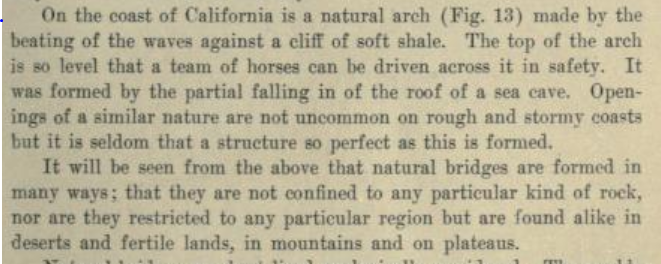
Santa Cruz Natural Bridge
From Popular Science Magazine

Source:
https://archive.org/stream/popularsciencemo78newyuoft#page/426/mode/2up
Source:
https://archive.org/stream/popularsciencemo78newyuoft#page/426/mode/2up
Thursday, May 08, 2014
Horse Breeds
It is believed that the forerunner of the Lipizzan was bred in Carthage, more than 2,000 years ago. The Carthaginian stock was bred to the Vilano, a sturdy Pyrenees horse, and with Arab and Barbary strains. The result became the fabled Andalusian of ancient Spain.
During Spain's 700 years of Moorish domination, the breed remained essentially the same. Occasional crossing with fresh Arab and Oriental blood by the breeders of Cordoba and Granada assured that the fleetness and agility so prized by the Arabs remained qualities inherent in the stock. The Spanish began to export the horses after Spain rid itself of Moorish rule. The most notable stud farms were established in Italy and Frederiksborg, Denmark. The Danes produced excellent stock from the Spanish progenitors; the Italian "Neapolitan" bloodline became famous in Europe.
Archduke Maximilian, later Emperor of Austria, began breeding Spanish horses there about 1562. Eighteen years later, Archduke Karl, ruler of four Austrian provinces, established a royal stud farm in Lipizza, located in the hills of Karst, near Trieste.
Fresh Spanish stock was systematically added to the blood line at intervals to maintain the strength of the breed. Oriental stallions were used occasionally for the same purpose. In the 17th and 18th centuries, horses from the northern Italian stud farm at Polesnia and the highly regarded Neapolitan strain were brought to Lipizza to mingle with the resident stock and the descendants of the original Spanish line out of Denmark and Germany.
From 1809 to 1815 they lived in the lowlands of the TISZA River, which flows into the Danube. The land was hard on them. It took several years and an infusion of fresh blood to recapture the vitality and high standard of the line. In May of 1915, the Lipizzans were split up. One group was taken to Laxenburg, near Vienna, and the other to Kladrub.
The fall of the Austrian House of HABSBURG in 1918 brought about the break up of the old Austrian Empire. Lipizza became a part of Italy. The Italian and Austrian governments divided the Lipizzaner herd equally. The Republic of Austria took their horses to Piber in Steiermark. Piber, a privately owned stud farm, was founded in 1798 to breed calvary mounts for the army. In 1858, it became a government breeding farm and produced Lipizzans of another and lighter strain for stud purposes in the provinces.
http://www.lipizzaner.com/
One example of the Spanish horse's influence is the American Quarter horse, whose development traces from the Colonial Short Horse-an animal of Spanish heritage-so named because it was unbeatable in short-distance races. The Short Horse was also crossed with a number of English Thoroughbreds when they were imported to what is now the United States. This mixing of blood produced most of the modern North American breeds, including the Quarter Horse, Morgan, American Saddlebred and the original American Thoroughbred. Ironically, the very breeds that the Andalusian spawned were to be his near undoing. Size became the fad in Europe. The Neapolitan, the Norman and the English Thoroughbred grew in popularity and in numbers until finally, they surpassed the position of the Spanish horse. The Andalusian breed was all but extinct in all areas except Spain and Portugal, where it became known as the Lusitano.
Then tragically, the plague followed by famine, nearly pushed the breed into oblivion. Fortunately, the horses survived in a few mountainous areas of Spain, notably at the Carthusian Monastery. The animals of this herd are today known as the Carthusians, the finest of the Spanish horses. In order to conserve the rare horses for breeding, the government of Spain placed an embargo on their export. For more than 100 years, the Andalusian was virtually unseen by the rest of the world. Then in the 1960's the export ban was lifted.
Now the popularity of the Andalusian horse is once again on the rise. Horsemen are rediscovering the traits that made the Andalusian the most sought-after horse in the world; the strength, agility, beauty, pride and docility bred for centuries into the Spanish horse. The Spanish stallions are unique because they are fiery and tractable.
This seeming contradiction stems from the edict of King Ferdinand of Spain, who enforced the old law that gentlemen must ride only stallions. This severe edict must have resulted in a few Spanish grandees being dumped on their heads, until horsemen began to breed their steeds for good temperament, knowing that they would not only have to ride stallions, but they would also be selling saddle stallions for a living.
The temperament, agility and strength of the Andalusian are again being sought after for dressage purposes. Dressage and the Spanish horse were almost synonymous in the beginning. The Spanish horse was so strong and agile that he could be trained to do amazing things, and the techniques that are now recognized as modern dressage were actually methods used to train the superior war-horses.
The Andalusian was so adept at this training that nearly all of the oldest and most famous riding schools started with Spanish horses. The best example of this is the Spanish Riding School in Austria, thus named for the Spanish horses that it used. The Lipizzan breed is an ancestor to the Andalusian, being almost totally of Spanish blood. As recently as 1968, a four-year-old stallion of the Carthusian line of the Andalusian was imported to rejuvenate the present line of Lipizzans in Austria.
Although less popular today among dressage horse breeders, the Spanish Andalusian is still a superior dressage mount. Occasionally overlooked by modern dressage riders, who consider him a "circus horse," the Andalusian significantly contributed to the Thoroughbred and most of the other popular European dressage breeds.
Nonetheless, the Andalusian is proving that he is not only suitable, but perhaps the best choice for the dressage arena. The list of the breed's winnings and the spread of its fame is limited only by its rarity. The Andalusian is excelling in other areas as American horsemen discover his great level of versatility. As a Western-riding horse, his skills are surpassed only by his grandchild-the Quarter Horse. However, when it comes to agility and the ability to work cattle, there is none better than the Andalusian. After all, he has been through countless battles with wild and deadly Iberian bulls.
For well over 1,000 years, he has worked at close quarters with these bulls, both in and out of the bullfighting arena. With death only inches away, he has had to carry his rider close enough to a maddened bull to place a rose between his horns and then whisk away before being gored. When not in the arena, he was the only horse quick enough to work the unpredictable and dangerous herds.
As a show and parade horse, the Andalusian's trademark movements, combined with his noble appearance with a long, lush mane and tail, make him a winner. His shiny gray or white coat glistens as he moves with all of the pride and style bequeathed to him by his ancestors who carried Caesars and kings in their day of triumph and splendor.
His strength and boldness make him a very good hunter and jumper. His agility and endurance make him ideal for trail riding cross-country. Generally, the Andalusian is a horse for all seasons and for all sports, even though he is a relative newcomer to the United States. Not until 1965 were the first Andalusians registered in this country. Today, their numbers are only about 700, making them precious as gold to their owners.
During Spain's 700 years of Moorish domination, the breed remained essentially the same. Occasional crossing with fresh Arab and Oriental blood by the breeders of Cordoba and Granada assured that the fleetness and agility so prized by the Arabs remained qualities inherent in the stock. The Spanish began to export the horses after Spain rid itself of Moorish rule. The most notable stud farms were established in Italy and Frederiksborg, Denmark. The Danes produced excellent stock from the Spanish progenitors; the Italian "Neapolitan" bloodline became famous in Europe.
Archduke Maximilian, later Emperor of Austria, began breeding Spanish horses there about 1562. Eighteen years later, Archduke Karl, ruler of four Austrian provinces, established a royal stud farm in Lipizza, located in the hills of Karst, near Trieste.
Fresh Spanish stock was systematically added to the blood line at intervals to maintain the strength of the breed. Oriental stallions were used occasionally for the same purpose. In the 17th and 18th centuries, horses from the northern Italian stud farm at Polesnia and the highly regarded Neapolitan strain were brought to Lipizza to mingle with the resident stock and the descendants of the original Spanish line out of Denmark and Germany.
From 1809 to 1815 they lived in the lowlands of the TISZA River, which flows into the Danube. The land was hard on them. It took several years and an infusion of fresh blood to recapture the vitality and high standard of the line. In May of 1915, the Lipizzans were split up. One group was taken to Laxenburg, near Vienna, and the other to Kladrub.
The fall of the Austrian House of HABSBURG in 1918 brought about the break up of the old Austrian Empire. Lipizza became a part of Italy. The Italian and Austrian governments divided the Lipizzaner herd equally. The Republic of Austria took their horses to Piber in Steiermark. Piber, a privately owned stud farm, was founded in 1798 to breed calvary mounts for the army. In 1858, it became a government breeding farm and produced Lipizzans of another and lighter strain for stud purposes in the provinces.
http://www.lipizzaner.com/
One example of the Spanish horse's influence is the American Quarter horse, whose development traces from the Colonial Short Horse-an animal of Spanish heritage-so named because it was unbeatable in short-distance races. The Short Horse was also crossed with a number of English Thoroughbreds when they were imported to what is now the United States. This mixing of blood produced most of the modern North American breeds, including the Quarter Horse, Morgan, American Saddlebred and the original American Thoroughbred. Ironically, the very breeds that the Andalusian spawned were to be his near undoing. Size became the fad in Europe. The Neapolitan, the Norman and the English Thoroughbred grew in popularity and in numbers until finally, they surpassed the position of the Spanish horse. The Andalusian breed was all but extinct in all areas except Spain and Portugal, where it became known as the Lusitano.
Then tragically, the plague followed by famine, nearly pushed the breed into oblivion. Fortunately, the horses survived in a few mountainous areas of Spain, notably at the Carthusian Monastery. The animals of this herd are today known as the Carthusians, the finest of the Spanish horses. In order to conserve the rare horses for breeding, the government of Spain placed an embargo on their export. For more than 100 years, the Andalusian was virtually unseen by the rest of the world. Then in the 1960's the export ban was lifted.
Now the popularity of the Andalusian horse is once again on the rise. Horsemen are rediscovering the traits that made the Andalusian the most sought-after horse in the world; the strength, agility, beauty, pride and docility bred for centuries into the Spanish horse. The Spanish stallions are unique because they are fiery and tractable.
This seeming contradiction stems from the edict of King Ferdinand of Spain, who enforced the old law that gentlemen must ride only stallions. This severe edict must have resulted in a few Spanish grandees being dumped on their heads, until horsemen began to breed their steeds for good temperament, knowing that they would not only have to ride stallions, but they would also be selling saddle stallions for a living.
The temperament, agility and strength of the Andalusian are again being sought after for dressage purposes. Dressage and the Spanish horse were almost synonymous in the beginning. The Spanish horse was so strong and agile that he could be trained to do amazing things, and the techniques that are now recognized as modern dressage were actually methods used to train the superior war-horses.
The Andalusian was so adept at this training that nearly all of the oldest and most famous riding schools started with Spanish horses. The best example of this is the Spanish Riding School in Austria, thus named for the Spanish horses that it used. The Lipizzan breed is an ancestor to the Andalusian, being almost totally of Spanish blood. As recently as 1968, a four-year-old stallion of the Carthusian line of the Andalusian was imported to rejuvenate the present line of Lipizzans in Austria.
Although less popular today among dressage horse breeders, the Spanish Andalusian is still a superior dressage mount. Occasionally overlooked by modern dressage riders, who consider him a "circus horse," the Andalusian significantly contributed to the Thoroughbred and most of the other popular European dressage breeds.
Nonetheless, the Andalusian is proving that he is not only suitable, but perhaps the best choice for the dressage arena. The list of the breed's winnings and the spread of its fame is limited only by its rarity. The Andalusian is excelling in other areas as American horsemen discover his great level of versatility. As a Western-riding horse, his skills are surpassed only by his grandchild-the Quarter Horse. However, when it comes to agility and the ability to work cattle, there is none better than the Andalusian. After all, he has been through countless battles with wild and deadly Iberian bulls.
For well over 1,000 years, he has worked at close quarters with these bulls, both in and out of the bullfighting arena. With death only inches away, he has had to carry his rider close enough to a maddened bull to place a rose between his horns and then whisk away before being gored. When not in the arena, he was the only horse quick enough to work the unpredictable and dangerous herds.
As a show and parade horse, the Andalusian's trademark movements, combined with his noble appearance with a long, lush mane and tail, make him a winner. His shiny gray or white coat glistens as he moves with all of the pride and style bequeathed to him by his ancestors who carried Caesars and kings in their day of triumph and splendor.
His strength and boldness make him a very good hunter and jumper. His agility and endurance make him ideal for trail riding cross-country. Generally, the Andalusian is a horse for all seasons and for all sports, even though he is a relative newcomer to the United States. Not until 1965 were the first Andalusians registered in this country. Today, their numbers are only about 700, making them precious as gold to their owners.
The Friesian horse is the only horse breed native to the Netherlands where the Friesian has been known since as far back as the 13th century. At the start of the Christian era, the Friesian was used in battle1 and Friesian troops were documented in Britannia. In the 4th century, English writer Anthony Dent1 wrote about the presence of Friesian troops at Carlisle and their horses. Both cases probably involve Friesian mercenaries mounted on Friesian stallions. Anthony Dent and other writers indicate that the Friesian horse is the ancestor of both the British Shire breed and the Fell pony.
Since the 16th century, Friesians have been in Neaples. Jan van der Straat's 1568 painting shows "Phryso" owned by Don Juan from Austria.
In the 11th century, Willem de Veroveraar1 used horses that had a remarkable resemblance to the Friesian breed. From this period, there are many illustrations of knights riding Friesian-looking horses.
During the crusades and later, in the course of the Eighty Years’ War, it is very probable that the Friesian breed was crossed with Arabian and Andalusian horses.
The first written evidence of use of the name “Friesian horse” was an announcement in 1544 that German Elector Johann Friedrich von Sachsen came to the Reichstag in Spiers riding a Friesian stallion.3 Three years later, he rode the stallion in the Battle of Muhlberg and was recognised from afar by Emperor Charles V. Also an etching dating from 1568 of the stallion Phryso1 belonging to Don Juan of Austria in Napels is very well known. During the 17th century, the Friesian horse was well represented at the various riding schools where the haut école of equitation was practised.
Use of the Friesian horse, however, became increasingly limited to the current Dutch province of Friesland over the 18th and 19th centuries. Towards the end of the 19th century, the presence of the Friesian horse in the countryside of Friesland became an expression of the owner’s wealth with the breed used mostly to bring upper-class farmers to church. The horse was additionally used for entertainment in the form of ridden short-track trotting races.2 In these races, the horse was traditionally ridden with just a small orange blanket on its back. During this period, the Friesian horse was very likely used in the breeding of the Orlov as well as American trotters.
Monday, May 05, 2014
Subscribe to:
Posts (Atom)